Can I Charge My Hybrid Car at Home Without Breaking the Bank
Yes, you can charge your hybrid car at home and it is easier than you think. Whether you own a plug-in hybrid or a traditional hybrid, home charging options exist for every budget. You will learn about charging equipment, installation costs, and how to slash your fuel savings starting today.
So you bought a hybrid vehicle and now you are wondering, “Can I charge my hybrid car at home?” The short answer is absolutely yes. The longer answer is that it depends on the type of hybrid you own, the charging equipment you use, and a few other factors we will walk through together.
Charging a hybrid car at home is one of the best ways to save money on fuel. Instead of stopping at the gas station every week, you can plug in overnight and wake up with a full “tank” of electric power. It is convenient, cost-effective, and surprisingly simple. In this guide, we will cover everything you need to know about home charging for your hybrid vehicle.
Whether you drive a plug-in hybrid or a standard self-charging hybrid, this article has practical tips and real numbers to help you make the best decision. Let us dive in.
Key Takeaways
- Home charging is possible: Most hybrid cars can plug into a standard wall outlet or a dedicated home charging station.
- Level 1 charging costs almost nothing: You can use the cable that comes with your car and a regular wall outlet.
- Level 2 charging is faster: A dedicated 240V station charges your battery much quicker but requires professional installation.
- Tax credits and incentives help: Federal and state programs can offset the cost of buying and installing charging equipment.
- Fuel savings add up fast: Switching from gas to electric charging can save hundreds of dollars every year.
- Common mistakes to avoid: Using the wrong outlet or skipping electrical panel upgrades can cause problems down the road.
📑 Table of Contents
- Understanding Your Hybrid Car and How It Charges
- Can You Charge a Hybrid Car at Home With a Normal Outlet?
- Level 2 Home Charging: Faster and More Efficient
- How Much Does It Cost to Charge a Hybrid Car at Home?
- Tax Credits and Incentives for Home Charging
- Common Mistakes to Avoid When Charging at Home
- Expert Tips for Maximizing Your Home Charging Experience
- Is Home Charging Right for You?
- Final Thoughts
Understanding Your Hybrid Car and How It Charges
Before we talk about charging at home, it helps to understand what kind of hybrid vehicle you have. Not all hybrids work the same way, and that affects how you charge them.
Plug-In Hybrid Electric Vehicles (PHEVs)
A plug-in hybrid has a larger battery capacity than a regular hybrid. You can plug it into an external power source to recharge the battery. Popular models include the Toyota Prius Prime, Mitsubishi Outlander PHEV, and Ford Escape PHEV. These cars can run on electric power alone for a set distance, usually between 20 and 60 miles, before the gas engine kicks in.
With a PHEV, home charging is essential if you want to maximize your fuel savings. The good news is that you can use a standard household outlet to get started.
Traditional Hybrids (Self-Charging Hybrids)
Traditional hybrids like the standard Toyota Prius do not have a plug. Their hybrid battery recharges itself through regenerative braking and the gas engine. You cannot plug these cars into an external power source, so home charging in the traditional sense does not apply.
However, some traditional hybrids offer an “EV mode” for short distances at low speeds. This is powered by the battery, not by plugging in. If you own this type of car, your energy bill stays the same because the battery charges while you drive.
Can You Charge a Hybrid Car at Home With a Normal Outlet?
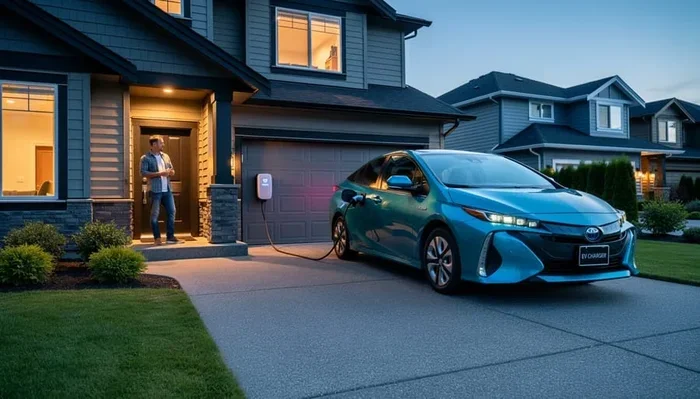
This is the most common question people ask. The answer is yes, but with some important caveats. Every plug-in hybrid comes with a charging cable that fits into a standard 120-volt wall outlet. This is called Level 1 charging.
What Is Level 1 Charging?
Level 1 charging uses a regular household wall outlet — the same one you use for your phone or laptop. You simply plug the charging cable that came with your car into any standard outlet in your garage or driveway.
Here is what you need to know about Level 1 charging:
- Speed: It adds about 3 to 5 miles of electric range per hour of charging.
- Time: A fully depleted battery can take 12 to 24 hours to charge completely.
- Cost: It costs almost nothing extra because it uses your existing wall outlet.
- Equipment: No additional purchases needed — the cable comes with your car.
For many people, Level 1 charging works perfectly. If you drive less than 30 miles a day and plug in overnight, you will always start the morning with a full charge. It is the simplest and cheapest way to charge a hybrid car at home.
Limitations of Level 1 Charging
While Level 1 charging is convenient, it has limits. If you have a long commute or regularly drive more than 40 miles a day, you may not get enough range from an overnight charge. Also, older homes may have outdated electrical panels that cannot safely handle extended charging sessions.
In these cases, upgrading to Level 2 charging is the better option.
Level 2 Home Charging: Faster and More Efficient
If you want to charge your hybrid vehicle faster and more reliably, Level 2 charging is the way to go. A Level 2 charger uses a 240-volt outlet — the same type that powers your clothes dryer or electric stove.
How Does Level 2 Charging Work?
You will need to purchase a dedicated home charging station, also called an EVSE (Electric Vehicle Supply Equipment). These units range from basic models to smart chargers with Wi-Fi connectivity and app controls.
Here is what makes Level 2 charging appealing:
- Speed: It adds 12 to 30 miles of electric range per hour of charging.
- Time: A fully depleted PHEV battery charges in 2 to 4 hours.
- Convenience: You can charge overnight and still have plenty of range by morning.
- Future-proofing: If you switch to a fully electric vehicle later, your charging equipment is already ready.
The charging speed of a Level 2 charger is a game-changer for daily drivers. You can plug in when you get home from work and have a full battery before you leave for your morning commute.
Installation Requirements for Level 2 Charging
Installing a home charging station requires a dedicated 240V circuit. Most homes need an electrical panel upgrade to support this. Here are the typical requirements:
- A 240-volt dedicated circuit (similar to what a dryer uses).
- A licensed electrician to install the circuit and the charger.
- An updated electrical panel if your current one cannot handle the extra load.
- A suitable location near your parking spot or garage.
The installation cost varies depending on your home and location. On average, expect to pay between $200 and $800 for the charger unit itself, plus $200 to $1,500 for professional installation. The total charging station cost can range from $400 to $2,300.
How Much Does It Cost to Charge a Hybrid Car at Home?
One of the biggest advantages of home charging is the cost savings. Let us break down the real numbers so you can see how much money you can save.
Level 1 Charging Cost
Since Level 1 charging uses a standard outlet, the cost is simply the electricity your home already uses. On average, electricity costs about $0.13 per kilowatt-hour in the United States. Charging a PHEV battery at home typically adds $1 to $3 to your energy bill per full charge.
Compare that to filling up a gas tank, which can cost $40 to $70 per fill-up. Over a month, the savings are significant.
Level 2 Charging Cost
The electricity cost for Level 2 charging is the same as Level 1 — you are paying for kilowatt-hours either way. The difference is that Level 2 charges faster and more efficiently, so there is less energy wasted during the charging process.
Most homeowners who switch to home charging report saving $50 to $150 per month on fuel costs compared to driving a gas-only car.
Charging Cost Comparison Table
| Charging Method | Cost Per Full Charge | Monthly Fuel Savings | Equipment Cost |
|---|---|---|---|
| Level 1 (Wall Outlet) | $1 – $3 | $50 – $100 | $0 (included with car) |
| Level 2 (Home Station) | $1 – $3 | $50 – $150 | $400 – $2,300 |
| Gasoline Only | $40 – $70 per fill-up | Baseline | N/A |
As you can see, the charging cost of a hybrid vehicle at home is dramatically lower than buying gas. The upfront investment in a Level 2 charger pays for itself within a few months for most drivers.
Tax Credits and Incentives for Home Charging
Here is some great news: you may not have to pay the full installation cost out of pocket. Several programs can help reduce the expense of charging equipment and home charging station setup.
Federal Tax Credit
The U.S. federal government offers a tax credit of up to 30% of the cost of purchasing and installing a home charging station, with a maximum credit of $1,000. This applies to Level 2 chargers and covers both the equipment and the installation cost.
To qualify, the charger must be installed in your primary residence and meet certain efficiency standards. Be sure to keep all receipts and documentation for your tax return.
State and Local Incentives
Many states offer additional incentives on top of the federal credit. Some programs include:
- State tax credits for EVSE purchase and installation.
- Rebates for purchasing a hybrid vehicle or electric vehicle.
- Reduced electricity rates for off-peak overnight charging.
- Free or discounted installation through utility company programs.
Check with your state energy office and local utility provider to see what programs are available in your area. These incentives can significantly reduce the total cost of setting up home charging.
Common Mistakes to Avoid When Charging at Home
Charging your hybrid car at home is straightforward, but there are a few common mistakes that can cause frustration or even safety issues. Here is what to watch out for.
Using an Unsuitable Outlet
Do not plug your charging cable into an old, worn-out outlet. If your outlet is loose, cracked, or connected to an overloaded circuit, it can overheat and create a fire hazard. Have an electrician inspect your outlets before starting regular home charging.
Ignoring Electrical Panel Capacity
Older homes often have 100-amp electrical panels that may not support the extra load of a Level 2 charger. Before purchasing a home charging station, ask an electrician to evaluate your panel’s capacity. Upgrading to a 200-amp panel may be necessary.
Skipping the Surge Protector
Power surges can damage your charging equipment. Always use a surge protector or have a dedicated circuit with built-in surge protection. This small step can save you from expensive repairs.
Forgetting to Check the Warranty
Some hybrid vehicle warranties cover charging equipment or installation costs. Before you pay for anything, check with your dealer or read your warranty documents carefully.
Expert Tips for Maximizing Your Home Charging Experience
Want to get the most out of charging your hybrid at home? Here are some expert-backed tips that make a real difference.
Charge Overnight
The best time to charge is overnight while you sleep. Electricity rates are often lower during off-peak hours, which means cheaper charging cost and less strain on the electrical grid. Set a timer if your charging equipment supports it, so the battery stops charging at a set time.
Keep Your Battery Between 20% and 80%
For optimal hybrid battery health, avoid charging to 100% every single night unless you need the full range. Keeping the charge between 20% and 80% reduces wear on the battery cells and extends their lifespan.
Use a Smart Charger
A smart home charging station can monitor your energy usage, adjust charging speed based on electricity rates, and even send notifications to your phone. These features help you save money and track your fuel savings over time.
Keep the Charging Port Clean
Dust and debris can accumulate in your charging port over time. Use a soft brush or compressed air to keep it clean. A dirty port can cause poor connection and slower charging speed.
Consider Solar Panels
If you really want to maximize savings, consider installing rooftop solar panels. Solar energy can power your home charging station for free during the day. This combo of solar panels and home charging is the ultimate way to eliminate fuel costs entirely.
Is Home Charging Right for You?
Now that you know the options, costs, and benefits, let us answer the big question: should you charge your hybrid car at home?
If you have access to a garage, carport, or dedicated parking spot with an electrical outlet, home charging makes sense for almost everyone. The convenience of plugging in every night and waking up with a full charge is hard to beat.
Even if you only use Level 1 charging with the cable that came with your car, you will still save money compared to filling up at the pump. And if you invest in a Level 2 charger, the savings and convenience increase dramatically.
The key is to match your charging setup to your driving habits. Short daily commute? Level 1 may be all you need. Longer commute or want faster charging? A Level 2 home charging station is worth the investment.
Final Thoughts
The answer to “Can I charge my hybrid car at home?” is a resounding yes. Whether you choose simple Level 1 charging with a standard wall outlet or invest in a Level 2 home charging station, the benefits are clear. You save money on fuel, reduce your carbon footprint, and enjoy the convenience of charging in your own driveway.
Start with what works for your budget and driving needs. You can always upgrade later. The most important step is just to start — plug in tonight and feel the difference tomorrow morning. Home charging for your hybrid vehicle is not just possible, it is one of the smartest moves you can make as a car owner.
Frequently Asked Questions
Can all hybrid cars be charged at home?
Only plug-in hybrid electric vehicles (PHEVs) can be charged at home using an external power source. Traditional self-charging hybrids do not have a plug and recharge their battery while driving through regenerative braking and the gas engine.
How long does it take to charge a hybrid car at home?
With Level 1 charging using a standard outlet, it takes 12 to 24 hours for a full charge. With a Level 2 home charging station, a full charge takes only 2 to 4 hours. The charging speed depends on your battery size and the charger’s power output.
What does it cost to install a home charging station?
The charging equipment itself costs between $200 and $800. Installation by a licensed electrician typically runs $200 to $1,500 depending on your home’s electrical panel and wiring needs. Federal tax credits can offset up to $1,000 of these costs.
Will charging my hybrid at home increase my electricity bill?
Yes, but only slightly. A full charge typically adds $1 to $3 to your energy bill. Compare that to spending $40 to $70 on gasoline every time you fill up, and the savings are obvious. Over a year, most drivers save hundreds of dollars.
Do I need a special outlet to charge my hybrid at home?
For Level 1 charging, any standard 120-volt wall outlet works. For Level 2 charging, you need a 240-volt dedicated circuit, similar to what a clothes dryer uses. An electrician can install this for you.
Are there any incentives for buying a home charging station?
Yes. The federal government offers a tax credit of up to 30% (max $1,000) for purchasing and installing a home charging station. Many states and utility companies also offer additional rebates and incentives. Check with your local energy programs for details.