Are High Beams and Brights the Same Thing for All Cars
Are high beams and brights the same thing? The short answer is yes — they refer to the same headlight setting on most vehicles. High beams and brights are just two names for the same powerful forward-facing light that gives you the best road visibility at night. However, not all cars handle these settings the same way, and using them incorrectly can blind other drivers. In this guide, we break down everything you need to know about headlight settings, headlight types, and how to use them safely.
Have you ever driven down a dark road and wondered whether your high beams and brights are actually the same thing? You are not alone. Many drivers use these terms interchangeably, but the truth is a little more nuanced than you might think. Understanding the difference between high beams and brights can make a huge difference in your driving safety, especially when you are out on the road after sunset.
In this article, we will answer the question are high beams and brights the same thing once and for all. We will cover how headlight settings work, the different headlight types available, and when you should use each setting. By the end, you will feel more confident behind the wheel at night. Let us dive in.
Key Takeaways
- High beams and brights are the same setting: Different names for the same full-power headlight mode on most vehicles.
- They boost road visibility significantly: High beams cast light much farther than low beams or dipped beams.
- Not all cars use the same term: Some vehicles label them differently, and automatic high beams add another layer of complexity.
- Using them incorrectly is dangerous: Flashing high beams at oncoming traffic can cause serious glare and accidents.
- Headlight types matter: LED headlights and halogen headlights behave differently in high beam mode.
- Know when to switch: Use high beams only in dark, low-traffic areas and dim them when other drivers are near.
📑 Table of Contents
What Are High Beams and Brights?
Before we get into the details, let us clear up the basics. When people ask are high beams and brights the same thing, they are usually confused by the different names car manufacturers and drivers use. The good news is that in most cases, the answer is a simple yes.
High beams and brights are just two common names for the same headlight setting. When you switch to this mode, your headlight range increases dramatically. The lights point straight ahead at a higher angle, casting light much farther down the road than your standard setting. This gives you more time to react to obstacles, animals, or changes in the road ahead.
Some drivers also call this setting full beam headlights. Others might simply say “the brights.” No matter what you call them, they all refer to the same function. The purpose is to maximize your road visibility in dark conditions where low beam headlights or a dipped beam setting would not be enough.
Why Do People Use Different Names?
The reason for the different names comes down to regional habits and car brands. In the United States, many drivers say “brights.” In other English-speaking countries, “high beams” is more common. Some car dashboards simply label the setting as “Hi” or a headlight icon with straight lines. This can confuse new drivers who are learning about headlight switch controls.
The important thing to remember is that no matter what you call them, they perform the same function. They give you the strongest, farthest-reaching light output from your vehicle’s headlights.
How Do High Beams Work?
Understanding how high beam headlights work helps you appreciate why they are so useful — and why you need to use them responsibly. The mechanism is actually pretty simple.
When you switch to high beam mode, the electrical current flows to the headlight bulb at full power. The reflector inside the headlight housing directs the light straight forward without any downward angle. This is different from low beams, which use a shield or a specific bulb design to aim the light slightly downward to avoid blinding other drivers.
The result is a much wider and longer light output. Where low beams typically light up about 50 to 100 feet ahead, high beams can reach 300 feet or more. That extra distance matters a lot when you are driving at highway speeds at night.
The Role of Headlight Types
Not all headlight types produce the same high beam performance. The bulb technology you have in your car affects how far and how bright the light reaches.
Halogen headlights are the most traditional type. They use a tungsten filament inside a gas-filled glass envelope. When you switch to high beams, the filament glows at full intensity. Halogen high beams are effective but tend to produce more heat and have a shorter lifespan compared to newer options.
LED headlights are becoming more common in modern vehicles. They use light-emitting diodes that are more energy-efficient and last longer. LED headlights in high beam mode produce a crisp, bright white light that improves road visibility significantly. They also reach full brightness almost instantly.
Some newer vehicles use adaptive headlights or automatic high beams. These systems use sensors to detect oncoming traffic and other vehicles. They automatically switch between high and low beams without you needing to touch the headlight switch. This is a great glare reduction feature that makes night driving much safer.
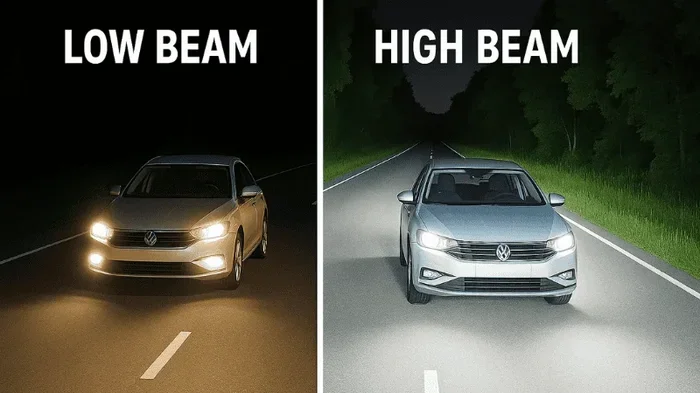
High Beam vs Low Beam: The Core Difference
To really understand high beams and brights, it helps to compare them directly with low beams. The low beam vs high beam distinction is one of the most important concepts in nighttime driving.
Low beams, also called dipped beams, aim the light downward toward the road. This prevents glare for drivers coming toward you or ahead of you. High beams, or brights, aim the light straight ahead at a higher angle. This gives you maximum visibility but can temporarily blind other drivers if they are close.
Here is a quick comparison of the two settings:
- Low beams: Light points downward, shorter range, safer around other traffic.
- High beams: Light points straight ahead, longer range, best for dark empty roads.
- Dipped beam: Another term for low beam, used in many countries.
The key takeaway is that high beams give you more light output but require more responsibility. You must know when to switch back to low beams to keep everyone on the road safe.
Are High Beams and Brights the Same Thing for All Cars?
Now for the big question. Are high beams and brights the same thing for all cars? The answer is mostly yes, but there are some exceptions and nuances worth knowing about.
In the vast majority of vehicles, high beams and brights refer to the exact same setting. Whether you drive a sedan, SUV, truck, or minivan, the high beam setting activates your full-power forward-facing lights. The dashboard icon is usually the same too — a headlight symbol with straight horizontal lines.
However, some factors can create confusion:
- Different dashboard labels: Some cars show “Hi,” others show “High Beam,” and a few might not label it clearly at all.
- Automatic systems: Vehicles with automatic high beams may not have a manual high beam setting in the traditional sense. The system handles the switching for you.
- Headlight switch designs: The headlight switch location and design vary by manufacturer. Some use a lever on the steering column, while others use a knob or button on the dashboard.
- Aftermarket upgrades: If you have installed aftermarket headlight bulbs or LED kits, the high beam behavior might differ slightly from factory settings.
Despite these variations, the core function remains the same. High beams and brights are the same setting in virtually every car on the road today. The differences are mostly in how the system is labeled or controlled, not in what the lights actually do.
What About Adaptive Headlights?
Adaptive headlights are an exciting development in automotive lighting. These systems go beyond simple high and low beam settings. They can pivot the light direction based on your steering angle, adjust the brightness based on traffic conditions, and even change the light pattern to avoid shining into oncoming drivers’ eyes.
With adaptive systems, the line between high beams and low beams can blur. The system might give you high beam-like visibility in some areas while automatically dimming in others. This is a form of glare reduction that traditional high beams cannot offer.
If your car has adaptive headlights, you may not need to manually switch between high beams and low beams as often. The system handles it for you. But it is still good to understand how the manual settings work in case the automatic system needs to be overridden.
Do Headlight Bulb Types Affect High Beam Performance?
Yes, the type of headlight bulb you use matters. Here is how different headlight types compare in high beam mode:
- Halogen bulbs: Warm yellowish light, decent range, affordable to replace.
- LED bulbs: Bright white light, excellent range, energy-efficient, long-lasting.
- Xenon/HID bulbs: Very bright, bluish-white light, strong high beam output but slower to warm up.
Each type has its own strengths when it comes to light output in high beam mode. LED and HID bulbs generally outperform halogen in terms of brightness and reach. But regardless of bulb type, the high beam setting itself works the same way across all of them.
When Should You Use High Beams?
Knowing when to use your high beams is just as important as knowing what they are. Using high beams at the wrong time can create dangerous situations for everyone on the road.
Here are the best situations to use your high beams or brights:
- Driving on dark rural roads: When there is no oncoming traffic and the road is unlit, high beams give you the best view of the road ahead.
- Open highways at night: On long stretches of highway with little traffic, high beams help you see farther and react faster.
- Poorly lit parking areas: When pulling into a dark parking lot, high beams can help you spot obstacles and pedestrians.
- Fog-free conditions: High beams work best in clear conditions. In fog or heavy rain, they can actually reflect back and reduce your visibility.
Here are situations where you should switch back to low beams:
- When oncoming traffic is near: Switch to low beams within 500 feet of an approaching vehicle.
- When following another car closely: High beams shining into the rearview mirror of the car ahead can distract their driver.
- In fog, heavy rain, or snow: The light reflects off precipitation and creates a glare that actually reduces your visibility.
- In well-lit urban areas: City streets usually have enough street lighting, making high beams unnecessary.
A Quick Tip for Using High Beams Safely
A great habit to build is to check your headlight settings every time you start driving in the dark. Many drivers forget to switch back to low beams after passing a dark stretch of road. This can blind drivers ahead of you without you even realizing it. A quick check of your dashboard can prevent this common mistake.
What If Your High Beams Are Not Working?
If you notice that one or both of your high beams are not working, it is important to address the issue quickly. A burned-out headlight bulb is the most common cause. But it could also be a wiring issue, a faulty headlight switch, or a problem with the relay.
Driving with only low beams at night significantly reduces your road visibility. If you notice a high beam is out, replace the bulb as soon as possible. If the problem persists, have a mechanic check the electrical system. Proper headlight alignment also matters — even a working high beam will not perform well if it is aimed incorrectly.
Common Mistakes Drivers Make with High Beams
Even experienced drivers make mistakes when it comes to using their high beams. Here are some of the most common errors and how to avoid them.
Leaving High Beams On Around Other Traffic
This is the number one mistake. Leaving your brights on when there are other vehicles nearby is not just rude — it is dangerous. The glare can blind oncoming drivers and distract the driver ahead of you. Always switch back to low beams when you are within 500 feet of another vehicle.
Using High Beams in Fog or Heavy Rain
It might seem logical to switch to high beams when visibility is poor. But in fog, rain, or snow, the extra light reflects off the water droplets and creates a wall of glare. Your driving safety actually decreases when you use high beams in these conditions. Stick with low beams or fog lights instead.
Ignoring Headlight Alignment
Even the best headlight types will not perform well if they are not properly aligned. Over time, headlights can shift due to wear and tear, heavy loads, or minor accidents. Misaligned high beams can blind other drivers even when you are using the correct setting. Have your headlight alignment checked during regular maintenance.
Not Using High Beams When You Should
On the flip side, some drivers are too cautious and never use high beams. This can leave you with poor road visibility on dark roads, increasing the risk of accidents. If the road is clear and there is no oncoming traffic, do not be afraid to switch to your brights.
Relying Too Much on Automatic Systems
While automatic high beams are a great feature, they are not perfect. Sensors can get dirty, and the system may not always switch at the right moment. Do not become so reliant on automation that you forget how to manually control your headlight settings. Always stay alert and ready to adjust.
Expert Tips for Better Night Driving
Want to get the most out of your high beam headlights and improve your overall night driving experience? Here are some expert tips that make a real difference.
- Keep your headlights clean: Dirty headlight lenses scatter light and reduce light output. Clean them regularly with a headlight restoration kit.
- Check your bulbs annually: Replace headlight bulbs before they burn out. Dimming bulbs reduce your headlight range and driving safety.
- Adjust your rearview mirror: Use the night setting on your rearview mirror to reduce glare from vehicles behind you when you are using high beams.
- Clean your windshield: Streaks and grime on your windshield scatter high beam light and create distracting glare. A clean windshield makes a big difference.
- Know your vehicle’s system: Read your owner’s manual to understand exactly how your headlight switch and high beam controls work. Every car is a little different.
These small habits add up over time and can significantly improve your road visibility and safety during nighttime driving.
Conclusion
So, are high beams and brights the same thing? The answer is a clear yes for the vast majority of vehicles on the road. High beams and brights are simply two names for the same powerful headlight setting that gives you the best road visibility in dark conditions. Whether you call them high beams, brights, or full beam headlights, they all serve the same purpose.
Understanding how your headlight settings work — and when to use them — is one of the most important aspects of driving safety. Use high beams on dark, open roads, but always dim them when other drivers are near. Keep your headlight bulbs in good condition and make sure your headlight alignment is correct.
With the right knowledge and good habits, you can make nighttime driving safer and more comfortable for yourself and everyone around you. The road ahead is bright — just make sure you are using the right lights to see it.
Frequently Asked Questions
Are high beams and brights the same thing on every car?
Yes, in virtually every car, high beams and brights refer to the same setting. The only differences are in how the dashboard labels the setting or how the headlight switch is designed. The function is identical across all vehicle types.
When should I switch from high beams to low beams?
Switch to low beams when you are within 500 feet of oncoming traffic or when you are following another vehicle closely. Also switch back in fog, heavy rain, or well-lit urban areas. This ensures glare reduction and keeps driving safety high for everyone.
Can using high beams damage my headlights?
No, using high beams does not damage your headlight bulbs or the headlight system. The bulbs are designed to handle full power. However, leaving high beams on for extended periods in traffic can shorten the lifespan of the bulb slightly due to heat buildup.
Do LED headlights perform better in high beam mode than halogen?
Generally, yes. LED headlights produce a brighter, whiter light with better energy efficiency. In high beam mode, LEDs tend to offer superior light output and headlight range compared to traditional halogen bulbs.
What are automatic high beams and how do they work?
Automatic high beams use sensors to detect oncoming traffic and vehicles ahead. The system automatically switches between high and low beams to provide optimal road visibility without requiring you to adjust the headlight switch manually.
Is it illegal to drive with high beams on all the time?
While it is not technically illegal to have high beams on, it is illegal to use them in a way that blinds other drivers. Most traffic laws require drivers to dim high beams when approaching oncoming traffic or following another vehicle closely. Violations can result in fines or citations.
=== CLOSING ===
Are high beams and brights the same thing? Now you know the answer for sure. They are the same powerful headlight setting that gives you better road visibility at night. Use them wisely, keep your lights well-maintained, and always prioritize safety on the road. Share this guide with a friend who might benefit from a clearer understanding of their headlight settings. Safe travels!