Does Mazda Still Use Ford Engines in 2024 and Beyond
Does Mazda still use Ford engines? The short answer is no. Mazda and Ford ended their engine-sharing partnership years ago, and Mazda now relies on its own SkyActiv technology. Today, Mazda builds all of its engines in-house, giving drivers more power, better fuel economy, and improved reliability.
Key Takeaways
- Mazda no longer uses Ford engines: The partnership ended, and Mazda now builds all engines independently.
- SkyActiv technology changed everything: Mazda’s proprietary engine design delivers better performance and efficiency.
- Ford and Mazda are still connected in other ways: They share some vehicle platforms but not engines.
- Older Mazda models did use Ford engines: Models from the 1990s to mid-2010s often shared Ford powertrains.
- Mazda owners benefit from this shift: In-house engines mean better tuning, reliability, and fuel economy.
- Regular maintenance still matters: Keeping up with oil changes and belt replacements helps your Mazda engine last longer.
📑 Table of Contents
- The History of Mazda and Ford’s Partnership
- What Engines Mazda Used to Get from Ford
- What Changed in 2024 and Beyond
- Mazda’s Current Engine Lineup
- How Mazda’s SkyActiv Technology Changed Everything
- What This Means for Mazda Owners
- Comparing Mazda Engines to Old Ford Engines
- The Future of Mazda Engines
- Conclusion
The History of Mazda and Ford’s Partnership
For decades, Mazda and Ford had a close relationship. They shared money, technology, and even engines. Many car buyers did not even know their Mazda used a Ford engine. This partnership shaped the auto industry for a long time.
Ford started buying a small stake in Mazda in the 1970s. Over time, that stake grew. By the 1990s, Ford owned about 33 percent of Mazda. This meant Ford had a lot of say in how Mazda made cars. And one big part of that was engines.
During this time, many popular Mazda models used Ford engines. The Mazda 626, the Mazda MX-6, and the Mazda B-Series trucks all shared Ford parts. This was common in the auto world. Companies often share parts to save money and time.
But things changed over the years. Ford slowly sold off its Mazda shares. By 2015, Ford owned almost nothing in Mazda. The partnership was not over completely, though. The two companies still worked together on some projects. But the engine-sharing days were coming to an end.
So what does this mean for car buyers today? Does Mazda still use Ford engines? The answer is a clear no. Let us look at why and how things changed.
What Engines Mazda Used to Get from Ford
Mazda used several Ford engines over the years. These engines powered some of Mazda’s most popular models. Here is a look at what was shared.
The Ford Duratec Engine Family
The Ford Duratec engine was one of the most common shared engines. Mazda used versions of this engine in the Mazda 6 and the Mazda CX-9. These were V6 engines. They were reliable and offered good power. Many drivers still remember these cars fondly.
The Ford MZR Engine Line
The MZR engine name actually stands for Mazda. But Ford used the same engine block for its own cars. This is how close the two companies were. The MZR came in different sizes. Some were 4-cylinder engines. Others were larger. They powered everything from sedans to SUVs.
The Ford Ranger and Mazda B-Series Connection
Ford and Mazda also shared truck engines. The Mazda B-Series pickups used Ford engines. In return, Ford sold a version of the B-Series as the Ford Ranger in some markets. This was a smart move for both companies. It saved them millions in engine development costs.
What Changed in 2024 and Beyond
Mazda made a big decision to stop using Ford engines. This happened gradually. By the mid-2010s, most new Mazda models used Mazda-built engines. The last Mazda models that used Ford engines were phased out. Today, every new Mazda comes with a Mazda engine.
So why did Mazda make this change? There are several reasons.
- More control over quality: Mazda could make sure every engine met its high standards.
- Better fuel economy: Mazda’s own engines are designed for efficiency.
- Unique technology: Mazda wanted to stand out with its own innovations.
- Brand identity: Mazda wanted to be known for its own engineering.
Ford and Mazda still share some things today. They share some vehicle platforms. They work together on safety features. But engines are no longer part of the deal. This is a big shift for both companies.
If you own an older Mazda, you might still have a Ford engine under the hood. That is perfectly fine. Does your car run better with a new serpentine belt? Yes, it does. Keeping up with basic maintenance helps any engine, whether it is a Ford or a Mazda engine. Regular care goes a long way.
Mazda’s Current Engine Lineup
Today, Mazda builds all of its own engines. These engines are modern, efficient, and powerful. Mazda has invested heavily in its engine technology. Here is a look at what Mazda offers now.
SkyActiv-G Gasoline Engines
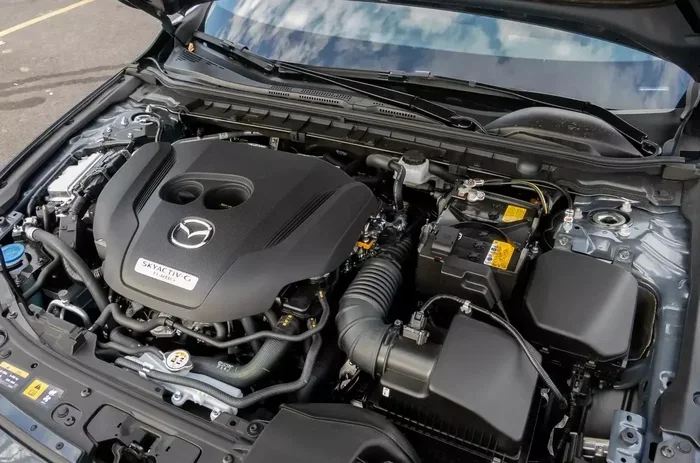
The SkyActiv-G engines are Mazda’s main gasoline engines. They come in 1.5-liter, 2.0-liter, and 2.5-liter sizes. These engines use high compression. This means they squeeze more power from less fuel. The result is great fuel economy without losing performance.
Many Mazda owners love these engines. They are smooth, quiet, and responsive. The 2.5-liter SkyActiv-G engine is especially popular. It powers the Mazda CX-5, the Mazda 6, and the Mazda CX-50. It offers plenty of power for daily driving and road trips.
SkyActiv-X Engine
Mazda also offers the SkyActiv-X engine. This is a very special engine. It uses a technology called compression ignition. This is similar to how diesel engines work. But it runs on regular gasoline.
The SkyActiv-X engine is a game changer. It offers the power of a gasoline engine with the efficiency of a diesel. This is a big deal for car buyers who want both performance and fuel savings.
SkyActiv-D Diesel Engines
Mazda also makes diesel engines. These are called SkyActiv-D engines. They are available in some markets, but not all. Diesel engines offer great fuel economy and strong low-end torque. They are a good choice for drivers who tow or carry heavy loads.
How Mazda’s SkyActiv Technology Changed Everything
Mazda’s SkyActiv technology is the reason the company no longer needs Ford engines. This technology covers everything from engines to transmissions to car bodies. It is a complete approach to building better cars.
SkyActiv engines use very high compression ratios. Most regular engines have a compression ratio of about 10 to 1. SkyActiv engines go up to 13 to 1 or even higher. This means more power from less fuel. It also means fewer emissions.
Mazda also redesigned the engine internals. They used lighter materials. They made the engine parts stronger. This means the engines last longer and need less maintenance.
Fuel Efficiency Gains
One of the biggest benefits of SkyActiv technology is fuel efficiency. Mazda engines are among the most efficient in the industry. A Mazda CX-5 with a SkyActiv engine can get over 30 miles per gallon on the highway. That is excellent for a compact SUV.
Better fuel economy saves drivers money at the pump. It also helps the environment. Less fuel burned means fewer emissions. This is a win for everyone.
Performance Improvements
Mazda did not sacrifice performance for efficiency. SkyActiv engines are also very powerful. The 2.5-liter turbo engine in the Mazda CX-50 MX-5000 makes over 250 horsepower. That is more than some V6 engines from just a few years ago.
Mazda also focused on how the engine feels. The throttle response is quick. The power delivery is smooth. Driving a Mazda with a SkyActiv engine is a joy. It feels modern, refined, and engaging.
If you are curious about how engine choices affect your fuel costs, does sport mode save gas? In most cases, sport mode uses more fuel because the engine works harder. It is better for spirited driving, not for saving gas.
What This Means for Mazda Owners
If you own a Mazda, this shift away from Ford engines is good news. Here is what it means for you.
Better Reliability
Mazda’s own engines are very reliable. They are designed and tested by Mazda engineers. They are built to Mazda’s exact standards. This means fewer surprises and less downtime.
Easier Maintenance
When your Mazda uses a Mazda engine, maintenance is simpler. You do not need to hunt for Ford-specific parts. Most auto shops can service a Mazda engine with ease. Oil changes, belt replacements, and spark plug swaps are all straightforward.
Speaking of oil changes, does Mobil 1 really last 10,000 miles? Many Mazda owners use synthetic oil like Mobil 1 for longer intervals. Always check your owner’s manual for the right oil type and change schedule.
Better Parts Availability
Mazda engines use widely available parts. You are not tied to a specific Ford part that might be harder to find. This saves time and money on repairs.
Strong Resale Value
Cars with in-house engines often hold their value better. Buyers trust Mazda’s engineering. They know the engine was designed and built by the same company that made the car. This gives buyers confidence.
Comparing Mazda Engines to Old Ford Engines
How do Mazda’s current engines compare to the old Ford engines they used to share? Here is a quick look.
| Feature | Old Ford Engines (Shared) | Current Mazda SkyActiv Engines |
|---|---|---|
| Built by | Ford | Mazda |
| Fuel Economy | Average | Excellent |
| Power Output | Good | Very Good to Excellent |
| Reliability | Good | Very Good |
| Maintenance Cost | Moderate | Low to Moderate |
| Technology | Standard | Advanced (SkyActiv) |
| Compression Ratio | 10:1 | 13:1 to 16:1 |
The differences are clear. Mazda’s current engines are better in almost every way. They are more efficient, more powerful, and more reliable. This is the result of years of investment in Mazda’s own technology.
If you are wondering about fuel options for your Mazda, can I use unleaded 88 in my car? Most Mazda vehicles run fine on regular unleaded fuel. Check your owner’s manual to be sure. Using the right fuel helps your engine perform at its best.
The Future of Mazda Engines
What does the future hold for Mazda engines? The company is focused on innovation. Mazda is investing in electric and hybrid technology. But the company is also keeping its combustion engines strong.
Mazda has said it will not abandon gas engines anytime soon. Instead, it will make them better. The SkyActiv technology will continue to evolve. Mazda is also working on more efficient engines for the future.
Mazda is also exploring rotary engines again. The company brought back a small rotary engine as a range extender in the MX-30 EV. This shows Mazda’s commitment to using its unique technology. The rotary engine is part of Mazda’s identity.
One thing is clear: Mazda will continue to build its own engines. The company has the expertise, the technology, and the vision. Ford engines in Mazda cars are a thing of the past. The future is Mazda.
Conclusion
Does Mazda still use Ford engines? No, not anymore. Mazda ended its engine-sharing partnership with Ford years ago. Today, every Mazda vehicle comes with a Mazda-built engine. These engines use the advanced SkyActiv technology. They offer excellent fuel economy, strong performance, and great reliability.
The Ford-Mazda partnership was important in automotive history. It helped both companies grow. But Mazda has moved on. The company now stands on its own engineering strength. Mazda owners can feel confident knowing their car has an engine designed and built by Mazda.
If you drive a Mazda, take pride in its engineering. Keep up with regular maintenance. Use quality oil and parts. Your Mazda engine will serve you well for many miles to come. The future is bright for Mazda. And it is all powered by Mazda’s own engines.
Keep learning about your car. Whether you are curious about does your car run better with a new serpentine belt, does sport mode save gas, or does Mobil 1 really last 10,000 miles, staying informed helps you be a better car owner. Knowledge is power. And a well-maintained car is a happy car.
Frequently Asked Questions
When did Mazda stop using Ford engines?
Mazda gradually stopped using Ford engines in the mid-2010s. By around 2015, most new Mazda models used Mazda-built engines. The last shared engines were phased out as Ford reduced its stake in Mazda.
Which Mazda models used Ford engines?
Several Mazda models used Ford engines. These include the Mazda 626, Mazda MX-6, Mazda B-Series trucks, and some versions of the Mazda CX-9. Older models from the 1990s through the mid-2010s are most likely to have Ford engines.
Is Mazda’s SkyActiv engine better than old Ford engines?
Yes, in most cases. SkyActiv engines offer better fuel economy, higher compression ratios, and more advanced technology. They are also more reliable and cheaper to maintain than the older shared Ford engines.
Are Ford and Mazda still partners today?
Ford and Mazda still have some business ties. They share vehicle platforms and work together on safety technology. But they no longer share engines. Each company builds its own powertrains now.
Can I still find Ford-powered Mazda models on the used market?
Yes. Older Mazda models from the 1990s to mid-2010s may still have Ford engines. If you are buying a used Mazda, check the engine specs. You can find this information in the owner’s manual or by checking the vehicle identification number.
What should I use for oil changes in my Mazda?
Always use the oil type recommended in your Mazda owner’s manual. Many Mazda owners prefer synthetic oils like Mobil 1. Regular oil changes keep your engine running smoothly and help it last longer.
=== SEO TITLE ===
Does Mazda Still Use Ford Engines in 2024 and Beyond
=== META TITLE ===
Does Mazda Still Use Ford Engines in 2024? (No)
=== URL SLUG ===
does-mazdastill-use-ford-engines
=== OPENING SUMMARY ===
Does Mazda still use Ford engines? The answer is a clear and definitive no. Mazda and Ford ended their engine-sharing partnership years ago, and today every Mazda vehicle runs on a Mazda-built engine powered by SkyActiv technology. From the Mazda CX-5 to the Mazda 6, all current models feature engines designed and manufactured by Mazda alone. This shift gives Mazda owners better fuel economy, improved reliability, and stronger performance. In this article, we will explore the full history of the Ford-Mazda partnership, which engines were shared, and why Mazda made the move to go solo. Whether you are a current Mazda owner or shopping for a new car, understanding this change helps you make smarter decisions. Let us dive into the complete story of how Mazda broke free from Ford engines and built its own path forward.