Does the Toyota Camry Have a Tire Pressure Monitoring System
Yes, the Toyota Camry comes equipped with a tire pressure monitoring system on most model years. This system helps drivers maintain safe tire pressure and avoid costly repairs. Understanding how the TPMS works on your Camry can save you time, money, and keep you safe on the road.
The Toyota Camry has been one of the most popular sedans on the road for decades. Millions of drivers trust this car for daily commutes, road trips, and everything in between. With that trust comes a lot of questions about safety features and maintenance.
One question that comes up often is whether the Toyota Camry has a tire pressure monitoring system. The short answer is yes. Most modern Camry models include this important safety feature as standard equipment. But how does it work? When should you worry about the light on your dashboard? And what can you do to keep your tires in great shape?
In this article, we will walk you through everything you need to know about the Toyota Camry tire pressure monitoring system. We will cover how TPMS works, what the warning lights mean, how to reset the system, and tips for keeping your tires in top condition. Whether you drive a 2010 Camry or a brand-new 2024 model, this guide has you covered.
Key Takeaways
- Standard Safety Feature: Most Toyota Camry models come with a factory-installed tire pressure monitoring system.
- Two Types of TPMS: Direct sensors measure actual pressure, while indirect systems use wheel speed sensors.
- Reset is Simple: You can usually reset the TPMS light from inside the cabin with a few button presses.
- Low Pressure Is Dangerous: Driving on underinflated tires reduces fuel economy and increases blowout risk.
- Sensor Batteries Wear Out: TPMS sensor batteries typically last 5 to 10 years and need replacement.
- Regular Checks Still Matter: Even with TPMS, manually checking tire pressure monthly is a smart habit.
📑 Table of Contents
- What Is a Tire Pressure Monitoring System?
- Does the Toyota Camry Have a Tire Pressure Monitoring System?
- How to Check Tire Pressure on Your Toyota Camry
- Common TPMS Issues on the Toyota Camry
- How to Reset the TPMS on a Toyota Camry
- Maintaining Your Camry’s Tire Pressure Year-Round
- When to Replace TPMS Sensors on Your Toyota Camry
- How the Toyota Camry TPMS Compares to Other Toyota Models
- Expert Insights on Camry Tire Pressure Monitoring
- Common Mistakes Camry Owners Make with TPMS
- Conclusion
What Is a Tire Pressure Monitoring System?
A tire pressure monitoring system, commonly known as TPMS, is a safety feature that tracks the air pressure inside your tires. The system alerts you when pressure drops below a safe level. This helps prevent accidents caused by underinflated or overinflated tires.
There are two main types of TPMS found in vehicles today:
- Direct TPMS: This type uses a small sensor inside each tire. The sensor measures the actual air pressure and sends data to your car’s computer. If pressure drops significantly, a warning light appears on the dashboard.
- Indirect TPMS: This system does not have physical sensors inside the tires. Instead, it uses the wheel speed sensors from your anti-lock braking system. It compares how fast each wheel is spinning. A tire with low pressure has a smaller rolling radius and spins faster than the others. The system detects this difference and triggers a warning.
Most newer Toyota Camry models use direct TPMS. This gives you a more accurate reading of your tire pressure. Older models or base trims may use the indirect system. Either way, the goal is the same: keep you safe by warning you about tire pressure problems before they become dangerous.
Does the Toyota Camry Have a Tire Pressure Monitoring System?
The Toyota Camry has included tire pressure monitoring across most model years. Starting around 2007 and continuing through all recent generations, TPMS has been a standard feature on the Camry. Toyota takes safety seriously, and this system is a key part of that commitment.
Here is a quick breakdown by generation:
- 6th Generation (2002-2006): Some trims included TPMS, but it was not always standard. Higher-end trims like the SE and XLE were more likely to have it.
- 7th Generation (2007-2011): TPMS became standard across all trims. This was a major step forward for the Camry lineup.
- 8th Generation (2012-2017): Direct TPMS sensors were standard on every Camry model.
- 9th Generation (2018-Present): The latest Camry models continue to include direct TPMS as a standard safety feature.
Even if you buy a used Camry, there is a very good chance it has some form of tire pressure monitoring. You can always check your owner’s manual to confirm what your specific model year includes.
Where to Find the TPMS Warning Light
The TPMS warning light looks like a horseshoe shape with an exclamation point in the center. It appears on your dashboard when the system detects a problem. You might see it when you start the car and it goes away after a few seconds. That is normal. It is just the system doing a quick self-check.
If the light stays on while you are driving, that means something needs attention. It could be one or more tires that are underinflated. It could also mean a sensor has failed or the battery in a sensor needs replacing.
How to Check Tire Pressure on Your Toyota Camry
Checking your tire pressure regularly is one of the best things you can do for your Camry. Even with a tire pressure monitoring system in place, manual checks are still important. The TPMS only alerts you when pressure is significantly low. It does not tell you if your pressure is slightly below the ideal level.
Step-by-Step Tire Pressure Check
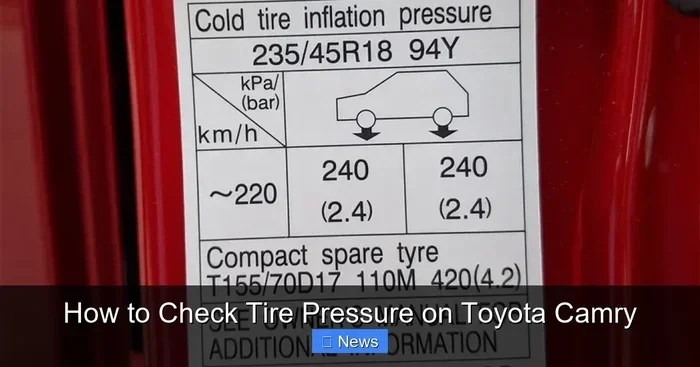
- Find the recommended pressure: Look at the sticker on the driver’s side door jamb. This sticker shows the correct tire pressure for your specific Camry model. The number is usually between 32 and 35 PSI for most Camry trims.
- Check when tires are cold: Always check tire pressure before driving or after the car has sat for at least three hours. Driving heats up the tires and increases the pressure reading.
- Remove the valve cap: Unscrew the small cap on the tire valve stem. Keep it in a safe place so you do not lose it.
- Press the gauge firmly: Press a tire pressure gauge onto the valve stem. You will hear a brief hiss of air. That is normal. Wait for the gauge to give you a reading.
- Compare the reading: Check your reading against the recommended number on the door jamb sticker.
- Add air if needed: If the pressure is low, use an air compressor to fill the tire to the correct level. You can find air pumps at most gas stations and auto parts stores.
- Replace the valve cap: Put the cap back on when you are done. This keeps dirt and moisture out of the valve stem.
You should check your Camry’s tire pressure at least once a month. Seasonal temperature changes can also affect pressure. Cold weather in winter can cause pressure to drop, while hot summer air can cause it to rise.
Recommended Tire Pressure for the Toyota Camry
The recommended tire pressure for most Toyota Camry models falls between 32 and 35 PSI. However, this can vary slightly depending on the model year and trim level. Always refer to the sticker on your driver’s side door jamb for the exact number. This sticker is your best guide because it is specific to your vehicle’s tire size and weight distribution.
Common TPMS Issues on the Toyota Camry
Like any car system, the tire pressure monitoring system on the Camry can sometimes have issues. Understanding these common problems can help you address them quickly and avoid unnecessary trips to the mechanic.
TPMS Light Stays On After Filling Tires
This is one of the most common complaints Camry owners have. You fill your tires to the correct pressure, but the warning light stays on. What is going on?
There are a few possible reasons:
- The system needs a reset: After you adjust tire pressure, the TPMS sometimes needs to be manually reset. We will cover how to do this in the next section.
- A sensor is damaged: The TPMS sensor inside the tire could be faulty. Potholes, road debris, and corrosion can all damage sensors over time.
- A sensor battery is dead: Each TPMS sensor has a small battery that typically lasts 5 to 10 years. When the battery dies, the sensor cannot send data to your car’s computer.
TPMS Light Flashes Then Stays On
If the TPMS light flashes for about 60 to 90 seconds after you start the car and then stays on, this usually indicates a malfunction in the system itself. It is not necessarily a tire pressure problem. This could mean a sensor is not communicating properly or there is an issue with the TPMS module.
TPMS Light Comes On in Cold Weather
Cold weather can cause tire pressure to drop. When the temperature falls, the air inside your tires contracts. This can trigger the TPMS light, especially in the early morning. If the light goes away after you drive for a while and the tires warm up, it was likely just a temperature-related pressure drop.
How to Reset the TPMS on a Toyota Camry
Resetting the TPMS light on your Camry is usually a straightforward process. However, the exact steps can vary slightly depending on your model year. Here is the general method that works for most Camry models:
- Make sure all tires are at the correct pressure: Before resetting, verify that every tire is inflated to the recommended PSI.
- Locate the TPMS reset button: On most Camry models, the reset button is located beneath the steering column. It may also be on the left side of the dashboard.
- Press and hold the button: With the car turned on (do not start the engine), press and hold the reset button until the TPMS light blinks three times.
- Start the engine: Start the car and let it idle for about 20 minutes. The system will recalibrate.
- Check the dashboard: The TPMS light should turn off after the recalibration is complete.
If the light comes back on after resetting, there may be an underlying issue that needs professional attention. In that case, it is a good idea to visit a trusted mechanic or a service center like Jiffy Lube for a diagnostic check. They can scan the TPMS system and identify any sensor problems.
Quick Tips for TPMS Reset
- Always check tire pressure before resetting the system.
- Drive at a steady speed for 10 to 15 minutes after resetting to help the system recalibrate.
- If the light returns within a few days, have a professional inspect the sensors.
- Keep your owner’s manual handy for model-specific instructions.
Maintaining Your Camry’s Tire Pressure Year-Round
Keeping your Toyota Camry’s tires properly inflated is about more than just turning off a warning light. Proper tire pressure affects your fuel economy, tire longevity, handling, and overall safety. A well-maintained tire pressure system also helps your car run better overall by reducing unnecessary strain on the engine.
Seasonal Tire Pressure Tips
Temperature changes throughout the year can have a big impact on your tire pressure. Here are some seasonal tips to keep in mind:
- Fall and Winter: As temperatures drop, tire pressure decreases by about 1 PSI for every 10-degree drop in ambient temperature. Check your pressure more frequently during cold months.
- Spring and Summer: Hot weather can cause pressure to rise. Do not let air out of your tires to compensate. The recommended pressure on the door jamb already accounts for normal temperature variations.
- Before Long Trips: Always check tire pressure before a road trip. Properly inflated tires improve fuel economy and reduce the risk of a blowout on the highway.
TPMS and Fuel Economy
Did you know that underinflated tires can reduce your fuel economy by up to 3 percent? That might not sound like much, but it adds up over time. The tire pressure monitoring system helps you catch low pressure early, which means you can fix it before it starts costing you money at the pump.
Keeping your tires properly inflated also helps your tires wear evenly. Uneven tire wear means you need to replace tires more often, which is an unnecessary expense. A simple monthly check can extend the life of your tires significantly.
When to Replace TPMS Sensors on Your Toyota Camry
TPMS sensors are built to last, but they do not last forever. The battery inside each sensor typically lasts between 5 and 10 years. When the battery dies, the sensor can no longer transmit pressure data to your car’s computer.
Here are some signs that your TPMS sensors may need replacement:
- The TPMS light comes on frequently without any obvious pressure issue.
- The light stays on even after you reset the system and confirm all tires are properly inflated.
- You have had the same sensors for more than 10 years.
- You recently replaced tires and the TPMS light appeared afterward. This could mean a sensor was damaged during the tire change.
Replacing a TPMS sensor typically costs between $50 and $100 per sensor, including labor. Some aftermarket sensors can be programmed to work with your Camry’s system. However, OEM Toyota sensors are always the safest choice for compatibility and reliability.
If you are unsure whether your sensors need replacement, a diagnostic scan at your local service center can confirm it. Many shops, including Jiffy Lube, offer TPMS diagnostics as part of their standard service packages.
TPMS Sensor Battery Replacement vs. Full Sensor Replacement
Some TPMS sensors allow you to replace just the battery. However, most modern sensors are sealed units, meaning the entire sensor must be replaced when the battery dies. This is an important consideration when budgeting for TPMS maintenance on your Camry.
How the Toyota Camry TPMS Compares to Other Toyota Models
The TPMS system on the Camry is very similar to what you will find on other Toyota models like the Camry’s sibling models and other Toyota sedans and SUVs. Toyota uses a consistent TPMS design across its lineup, which means the experience is familiar whether you drive a Camry, a Corolla, or a Highlander.
The main differences between models usually come down to the type of TPMS (direct vs. indirect) and the location of the reset button. The core functionality remains the same across the Toyota family. You get reliable pressure monitoring that helps keep you and your passengers safe.
For owners who also use the Toyota Connect app, keeping your app activated and synced with your car can provide additional alerts and maintenance reminders. You can activate the Connect app to get notifications about tire pressure and other important vehicle health updates right on your phone.
Expert Insights on Camry Tire Pressure Monitoring
Automotive experts consistently recommend that Camry owners pay close attention to their TPMS warnings. Many drivers ignore the TPMS light for weeks or even months. This is a risky habit. Underinflated tires are one of the leading causes of tire failure on the road.
Experienced mechanics also point out that the TPMS is a warning system, not a replacement for regular maintenance. The system is designed to alert you when pressure is dangerously low. It is not meant to tell you when pressure is slightly off. Staying proactive with manual checks and regular tire rotations will keep your Camry running safely and smoothly for years to come.
One expert tip from seasoned Toyota technicians: always keep a digital tire pressure gauge in your glove box. The gauges at gas stations are not always accurate. Having your own reliable gauge means you can check your pressure anytime, anywhere.
Common Mistakes Camry Owners Make with TPMS
Even the best car owners can make mistakes when it comes to tire pressure monitoring. Here are some common errors to avoid:
- Ignoring the TPMS light: The most common mistake is simply ignoring the warning. Even if the tires look fine to the naked eye, the pressure could be off by enough to cause problems.
- Only checking tires when the light comes on: Waiting for the warning light means you are already driving with low pressure. Preventative checks are much better.
- Overinflating tires to avoid the light: Some drivers overfill their tires so the TPMS light never comes on. Overinflated tires are just as dangerous as underinflated ones. They have less contact with the road, which reduces traction and handling.
- Forgetting to reset after adding air: If you fix a low-pressure issue but do not reset the system, the light will stay on even though the problem is solved.
- Assuming all four sensors work the same: Each sensor has its own battery. One sensor can fail while the others are still working perfectly. The TPMS light does not tell you which specific sensor or tire is the problem.
Avoiding these mistakes will help you get the most out of your Camry’s tire pressure monitoring system. It will also keep your tires lasting longer and your drives safer.
Conclusion
The Toyota Camry does come with a tire pressure monitoring system, and it has been a standard feature for many model years now. This system plays a vital role in keeping you safe by alerting you when tire pressure drops to an unsafe level. Understanding how the TPMS works, how to reset it, and when to replace sensors can save you time, money, and potentially prevent accidents.
Remember that the TPMS is a helpful tool, but it is not a substitute for regular tire maintenance. Check your tire pressure manually at least once a month, keep a quality gauge in your glove box, and never ignore a TPMS warning. Your Camry is a reliable car, and with proper tire care, it will continue to serve you well for many miles to come.
Take a few minutes today to check your Camry’s tire pressure. It is one of the simplest and most effective things you can do to maintain your vehicle and stay safe on the road.
Frequently Asked Questions
Can I drive my Toyota Camry with the TPMS light on?
You can drive short distances with the TPMS light on, but it is not recommended. The light means your tire pressure is likely too low, which can affect handling and increase the risk of a blowout. Check your tire pressure as soon as possible and inflate to the recommended level before driving long distances.
How much does it cost to replace a TPMS sensor on a Toyota Camry?
Replacing a single TPMS sensor typically costs between $50 and $100, including parts and labor. If multiple sensors need replacement, the cost will increase accordingly. OEM Toyota sensors may cost a bit more than aftermarket options, but they offer better compatibility and reliability.
How often should I check my Toyota Camry’s tire pressure?
You should check your tire pressure at least once a month. You should also check before long trips and whenever there is a significant change in temperature. The TPMS is a backup system, not a replacement for regular manual checks.
Will the TPMS light come on if I have a slow leak?
Yes, a slow leak will eventually cause the TPMS light to come on. The speed at which the light activates depends on how fast the tire is losing air. A very slow leak might take days or weeks to trigger the warning. This is why regular manual pressure checks are so important.
Can cold weather trigger the TPMS light on a Camry?
Yes, cold weather is a common reason for the TPMS light to activate. When temperatures drop, the air inside your tires contracts, causing pressure to decrease. If the pressure drops below the system’s threshold, the warning light will appear. Driving for a few minutes usually warms the tires and may turn the light off.
Is it safe to replace TPMS sensors myself?
If you have basic mechanical skills and the right tools, you can replace TPMS sensors yourself. However, the sensors need to be properly programmed to your Camry’s system after installation. If you are not comfortable with this process, it is best to have a professional handle the replacement to ensure proper function.