Air Pump for Car and Bike The Essential Roadside Tool
A portable air pump for car and bike is the most underrated roadside essential every driver should own. It lets you handle flat tires, low pressure, and emergencies without waiting for roadside assistance. Whether you drive daily or ride weekends, a tire inflator saves time, money, and stress on the road.
Every driver and cyclist knows the frustration of a flat tire. It happens at the worst possible moment. You are on a highway, running late, or stuck in a remote area with no cell signal. That is exactly when a reliable air pump for car and bike becomes your best friend. A good portable tire inflator takes seconds to get you back on the road. It is small, affordable, and incredibly useful. In this guide, we will walk you through everything you need to know about choosing and using the right air pump for your vehicles.
We will cover the different types of pumps available, what features matter most, and how to maintain your tires properly. Whether you are a daily commuter or a weekend adventurer, this article has practical tips you can use right away. Let us dive in and explore why every car and bike owner should keep a portable air compressor handy.
Key Takeaways
- Dual-purpose pumps work for both car and bike tires, making them versatile and cost-effective.
- 12V portable air compressors plug into your car’s cigarette lighter for on-the-go convenience.
- Digital tire gauges built into modern pumps take the guesswork out of tire pressure.
- Automatic shut-off features prevent over-inflation and protect your tires.
- Compact design means you can store your pump in the trunk or under a seat easily.
- Regular tire inflation improves fuel economy, safety, and tire lifespan significantly.
- Choosing the right PSI rating ensures your pump handles both car and bike tires effectively.
📑 Table of Contents
- Why Every Driver Needs an Air Pump for Car and Bike
- Types of Air Pumps for Car and Bike
- Key Features to Look for in an Air Pump
- How to Use an Air Pump for Car and Bike
- Common Mistakes to Avoid
- Top Benefits of Owning a Portable Air Pump
- How to Maintain Your Air Pump
- Expert Insights: What Mechanics Recommend
- Final Thoughts
Why Every Driver Needs an Air Pump for Car and Bike
Tire pressure affects everything. It impacts your safety, fuel efficiency, and how long your tires last. Yet most people ignore their tires until something goes wrong. A 12V air pump solves this problem before it becomes an emergency.
Safety First: Proper Tire Pressure Saves Lives
Under-inflated tires are dangerous. They reduce grip on wet roads. They increase stopping distances. They can even cause blowouts at high speeds. According to the National Highway Traffic Safety Administration, tire-related crashes account for thousands of accidents every year. Keeping your tires at the correct tire pressure is one of the simplest ways to stay safe.
Over-inflated tires are just as risky. They wear out the center of the tread unevenly. They provide a harsher ride and less traction. A digital tire gauge on your air compressor helps you hit the exact pressure every time.
Save Money on Fuel and Tire Replacement
Did you know that properly inflated tires improve fuel economy? The U.S. Department of Energy estimates that under-inflated tires waste about 3% of your fuel. Over time, that adds up to real money. Plus, tires that are consistently under or over-inflated need replacement much sooner. A portable tire inflator helps you avoid these costly problems.
For cyclists, proper tire inflation means smoother rides and fewer flats. Bike tires lose air faster than car tires. Checking pressure before every ride is a good habit. A compact bike tire pump makes this effortless.
Types of Air Pumps for Car and Bike
Not all pumps are the same. Different types serve different needs. Let us break down the main options so you can find the best fit.
12V Portable Air Compressors
These are the most popular air pumps for vehicles. They plug directly into your car’s cigarette lighter or power outlet. Most models are compact enough to fit in your trunk or glove box. They work great for both car tires and bike tires.
Key features of a good 12V pump include:
- Fast inflation speed — fills a car tire in 3 to 5 minutes
- Built-in LED light — helps in dark or nighttime situations
- Multiple nozzle attachments — fits Schrader and Presta valves
- Carrying case — keeps everything organized
- Low noise operation — no need to disturb others
Manual Hand Pumps
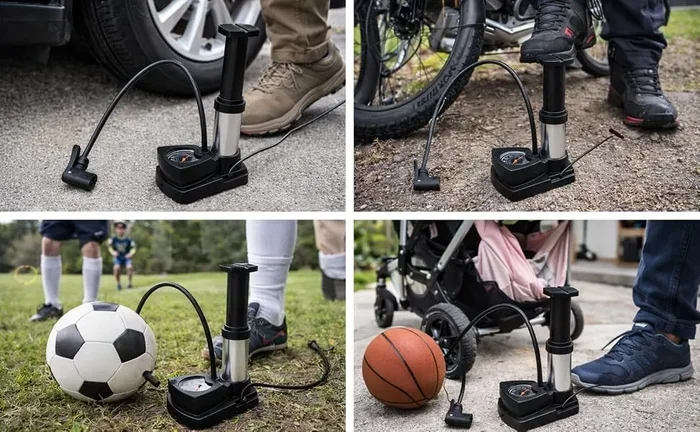
Manual pumps are lightweight and do not need electricity. They work well for bikes but can be tiring for car tires. A dual-purpose hand pump with a pressure gauge is a solid budget option. These are great for cyclists who want a lightweight backup.
CO2 Inflators
CO2 inflators use small cartridges of compressed carbon dioxide. They are popular among cyclists for quick roadside fixes. They are fast and compact. However, they are not ideal for car tires. A CO2 inflator works best as a bike emergency tool.
Heavy-Duty Stationary Compressors
These are the big units you see in garages and gas stations. They deliver high volume and consistent pressure. If you have a home garage, a stationary compressor is excellent for regular tire maintenance. But they are not portable, so they do not help on the road.
Key Features to Look for in an Air Pump
Not every pump is worth your money. Here are the features that separate a good portable tire inflator from a great one.
PSI Rating and Compatibility
The PSI rating tells you how much pressure the pump can deliver. Car tires typically need 32 to 35 PSI. Bike tires vary widely — road bikes need 80 to 130 PSI, while mountain bikes need 30 to 50 PSI. Choose a pump that covers the full range. A good dual-purpose air pump handles both with ease.
Check the maximum PSI before buying. If you ride road bikes, you need a pump that reaches at least 120 PSI. For cars, 150 PSI is more than enough.
Automatic Shut-Off
This feature is a game-changer. An automatic shut-off pump stops inflating once it reaches your preset pressure. You set the desired PSI, and the pump does the rest. This prevents over-inflation, which can damage your tires. It also saves you time and takes the guesswork out of the process.
Digital Display and Pressure Gauge
A digital tire gauge gives you precise readings. Analog gauges work too, but they are less accurate. A backlit digital screen is helpful for nighttime use. Look for pumps with clear, easy-to-read displays. This small detail makes a big difference in accuracy.
Speed and Power
Nobody wants to wait 20 minutes for a tire to fill. A good 12V air pump should fill a standard car tire in under 5 minutes. Check the airflow rate, measured in liters per minute. Higher airflow means faster inflation. For bikes, speed is less critical, but a quick inflate option is still nice to have.
Portability and Build Quality
Your pump should be lightweight and durable. You do not want a heavy unit that takes up half your trunk. Look for pumps made from sturdy materials that can handle road vibrations. A compact air compressor with a built-in storage compartment for the power cord and nozzles is ideal.
How to Use an Air Pump for Car and Bike
Using a portable tire inflator is straightforward once you know the steps. Here is a simple guide that works for most models.
For Car Tires
- Park your car on a flat surface and turn off the engine.
- Locate the tire pressure rating on the driver’s side door jamb.
- Remove the valve cap from the tire.
- Plug the pump into the cigarette lighter or power outlet.
- Attach the nozzle to the tire valve and press firmly.
- Set your desired PSI on the pump if it has a digital display.
- Turn on the pump and let it do its work.
- Wait for the automatic shut-off or check the gauge periodically.
- Remove the nozzle and replace the valve cap.
For Bike Tires
- Check your bike tire’s recommended PSI on the sidewall.
- Remove the valve cap. Note whether you have a Presta or Schrader valve.
- Attach the correct nozzle to your pump.
- Pump steadily until you reach the desired pressure.
- Remove the nozzle and replace the valve cap.
Pro tip: Keep a tire pressure monitoring system habit. Check your tire pressure at least once a month. Temperature changes affect pressure too. Cold weather can lower PSI, so check more often in winter.
Common Mistakes to Avoid
Even with a great air pump, people make mistakes that cause problems. Here are the most common ones and how to avoid them.
Over-Inflating Your Tires
This is the number one mistake people make. Over-inflated tires feel hard and provide a bumpy ride. They wear out the center tread quickly. In extreme cases, they can burst. Always use the automatic shut-off feature or monitor the digital gauge closely.
Ignoring the Recommended PSI
Every vehicle and bike has a recommended pressure range. Do not guess. Check the sticker on your car door or the sidewall of your bike tire. Using the wrong PSI affects handling, comfort, and safety.
Forgetting to Check for Leaks
If your tire loses air frequently, you may have a slow leak. A portable tire inflator fills the tire, but it does not fix the leak. Inspect your tires regularly. Look for nails, screws, or cracks in the sidewall. A small tire sealant can temporarily fix minor punctures until you get a proper repair.
Using the Wrong Nozzle
Car tires use Schrader valves. Many bike tires use Presta valves, which are thinner. Using the wrong nozzle can damage the valve or fail to inflate properly. Most quality pumps come with multiple nozzle adapters. Make sure you have them and know which one to use.
Top Benefits of Owning a Portable Air Pump
Still not convinced? Here are the top reasons a portable air compressor deserves a spot in your vehicle.
- Roadside independence — You do not need to wait for roadside assistance or a gas station air pump.
- Emergency readiness — A flat tire at midnight or on a deserted road becomes manageable.
- Cost savings — Avoid paying for air at gas stations or calling a tow truck.
- Improved tire lifespan — Correct pressure reduces uneven wear and extends tire life.
- Better fuel economy — Properly inflated tires reduce rolling resistance and save gas.
- Peace of mind — Knowing you are prepared for any tire emergency reduces travel stress.
A dual-purpose pump handles both your car and your bike. That means one device covers all your inflation needs. It is the most practical tool you can keep in your vehicle.
How to Maintain Your Air Pump
Your air pump for car and bike will last longer with proper care. Here are some simple maintenance tips.
- Store it in a cool, dry place — Heat and moisture can damage the motor and seals.
- Check the power cord regularly — Look for fraying or damage before each use.
- Clean the nozzles after use — Dirt and debris can clog the valve connections.
- Do not run the pump continuously for more than 10 minutes — Let it cool down between uses to prevent overheating.
- Replace the fuse if needed — Most pumps have a built-in fuse that is easy to swap.
Taking care of your tire inflator ensures it works when you need it most. A well-maintained portable tire inflator can last for years.
Expert Insights: What Mechanics Recommend
We asked a few automotive professionals what they look for in a portable air compressor. Here is what they had to say.
Jake M., ASE Certified Mechanic: “I always recommend a pump with an automatic shut-off and a digital display. It takes the guesswork out of inflation and prevents damage. Most drivers do not know their correct tire pressure, so a pump that tells them is invaluable.”
Sarah L., Bike Touring Enthusiast: “For cycling, I love a lightweight CO2 inflator for emergencies and a small hand pump for regular use. Having both covers every situation on the road.”
Dr. Tom R., Tire Safety Researcher: “Proper tire inflation is the single most overlooked safety factor in vehicles. A tire pressure monitoring system helps, but a reliable portable pump is the real game-changer for everyday drivers.”
These experts agree on one thing: a quality air pump is not a luxury. It is a necessity. Whether you drive a car or ride a bike, having the right tool for tire inflation keeps you safe and saves you money.
Final Thoughts
A good air pump for car and bike is one of those tools you never think about until you need it. And when you need it, you will be glad you have one. From portable tire inflators to 12V air compressors, the options are plentiful and affordable. The key is to choose a pump that fits your needs, check your tire pressure regularly, and use it correctly.
Do not wait for a flat tire to make this investment. A compact air compressor in your trunk or garage gives you confidence and independence on the road. It is a small purchase that delivers big returns in safety, savings, and peace of mind.
Keep your tires properly inflated. Keep your pump charged and ready. And always be prepared for the unexpected. Your future self will thank you the next time a tire issue comes up and you handle it like a pro.
Frequently Asked Questions
Can I use a car air pump on a bike tire?
Yes, most portable tire inflators work for both car and bike tires. You just need the right nozzle attachment. Make sure your pump can reach the PSI range your bike requires, especially if you ride road bikes that need higher pressure.
How long does it take to inflate a car tire with a portable pump?
A good 12V air pump fills a standard car tire in about 3 to 5 minutes. The time depends on how low the tire pressure is and the pump’s airflow rate. Models with higher airflow inflate faster.
Is a 12V air pump powerful enough for car tires?
Absolutely. Most 12V portable air compressors are designed specifically for car tires. They deliver enough pressure to reach 32 to 35 PSI, which is the standard for most passenger vehicles. Just make sure to run the engine while using it.
What PSI should my car tires be at?
The recommended tire pressure for your car is listed on a sticker inside the driver’s door jamb. It is usually between 30 and 35 PSI. Never exceed the maximum PSI listed on the tire sidewall. Use a digital tire gauge for accurate readings.
How often should I check my tire pressure?
Experts recommend checking your tire pressure at least once a month. Temperature changes can affect PSI, so check more often during seasonal shifts. A tire pressure monitoring system in your car helps, but a manual check with a gauge is still the best practice.
What is the difference between a portable air pump and a tire inflator?
The terms are often used interchangeably. A portable tire inflator is typically a smaller, lighter version of a portable air compressor. Both serve the same purpose of inflating tires. The main differences are size, power source, and features like automatic shut-off and digital displays.