Can You Jump-Start a Hybrid Heres What You Need to Know
Yes, you can jump-start a hybrid, but the process is different from a regular car. The 12-volt battery in a hybrid is what you boost, not the high-voltage hybrid battery. Knowing the right steps keeps you safe and prevents damage to the hybrid system. This guide covers everything you need to know about jump-starting a hybrid, from locating the 12V battery to using a hybrid jump box.
Have you ever been parked in a quiet lot, ready to go, only to hear silence when you turn the key? That sinking feeling is even worse when you drive a hybrid vehicle. You might wonder, Can You Jump-Start a Hybrid? The answer is yes, but you need to know the right steps. Hybrid cars have a unique powertrain that includes both a gasoline engine and an electric motor. This setup means the jump-start process is not the same as for a conventional car. Knowing how to safely boost a hybrid can save you from a long wait and prevent costly damage.
Many drivers assume they can just attach jumper cables and crank the engine like any other car. That is a dangerous mistake. Hybrids have a high-voltage battery that powers the electric motor, and a separate 12-volt auxiliary battery that runs the electronics and starter. When you try to jump-start a hybrid, you are only boosting the 12-volt battery. The high-voltage system stays completely isolated. This article will walk you through the entire process. You will learn where the 12V battery is located, what tools you need, and the exact sequence of steps. I will also share common errors to avoid and tips from hybrid experts. By the end, you will feel confident handling a dead hybrid battery on your own.
Can You Jump-Start a Hybrid? Absolutely. With the right knowledge and a little care, you can get your hybrid car running again in minutes. Let us dive into how hybrid vehicles start and why the process is different.
Key Takeaways
- Can You Jump-Start a Hybrid? Yes, but you boost the 12-volt auxiliary battery, not the high-voltage hybrid battery.
- Locate the 12V Battery First: It is often under the hood, in the trunk, or behind a rear seat, and you will find it labeled.
- Use the Right Tools: A hybrid jump box or standard jumper cables with a working conventional car will do the job safely.
- Follow the Safety Sequence: Connect positive to positive, negative to ground, and start the assisting vehicle first.
- Avoid Common Mistakes: Never try to jump-start the high-voltage battery; it can be dangerous and void your warranty.
- Prevent Future Issues: Keep your hybrid’s 12V battery healthy with regular checks and a maintainer charger.
📑 Table of Contents
How a Hybrid Vehicle Starts
Before you can boost a dead battery, you need to understand how a hybrid starts. Unlike a regular car that relies solely on a 12-volt battery to crank the engine, a hybrid uses a more complex system. The hybrid powertrain includes a high-voltage traction battery, an electric motor, and a gasoline engine. All of these work together to move the car.
The 12-volt auxiliary battery acts as the brain’s power source. It sends a signal to the hybrid system to wake up. Once the system is active, the electric motor can start the gasoline engine or drive the car on its own. If your 12V battery dies, the entire hybrid system goes dark. The car will not start, and you will hear no sound at all. This is why a dead 12V battery in a hybrid feels so alarming. You might think the high-voltage battery is dead too, but that is rarely the case.
The 12-Volt Battery vs. the High-Voltage Battery
The 12-volt battery in a hybrid is similar to the one in a conventional car. It powers the lights, infotainment, and starter motor. The high-voltage battery, however, is a completely different animal. It typically operates at 200 to 400 volts. This battery stores energy for the electric motor and is recharged through regenerative braking. You should never attempt to boost the high-voltage battery directly. The voltage is too high, and the terminals are often sealed and safety-shrouded.
Here is a simple breakdown of the two batteries in a hybrid:
- 12-Volt Auxiliary Battery: Powers the starter, lights, and computer systems. It is what you boost during a jump-start.
- High-Voltage Traction Battery: Powers the electric motor. It is recharged by the gasoline engine and regenerative braking. It is not used to crank the engine.
Why Hybrids Need a Special Approach
Because the high-voltage system is so powerful, manufacturers have built in multiple safety layers. The hybrid system automatically disconnects the high-voltage circuit when the car is off. This protects you from electric shock. However, you still must follow the correct procedure to boost the 12V battery. Jump-starting a hybrid incorrectly can trigger error codes, damage the power control unit, or void your warranty. Always consult your owner’s manual first. Every hybrid model has a specific location for the 12V battery and a designated jump-start terminal.
Quick Tip: Keep a printed copy of your hybrid’s jump-start instructions in the glovebox. When you are in a panic, you will not want to search for the manual.
| Step | Hybrid Vehicle | Conventional Car |
|---|---|---|
| Battery to Boost | 12-volt auxiliary battery only | 12-volt starter battery |
| High-Voltage Battery Involved? | No, never boost it directly | N/A (no high-voltage system) |
| Typical 12V Battery Location | Under hood, trunk, or rear seat (varies by model) | Under the hood |
| Safety Warning | Avoid contact with high-voltage orange cables | Standard battery acid precautions |
| Recommended Tool | Hybrid jump box or standard jumper cables | Standard jumper cables |
Can You Jump-Start a Hybrid? Yes, Here’s How
The short answer is yes, you can jump-start a hybrid. The process focuses entirely on the 12-volt auxiliary battery. You will use either a working conventional car and jumper cables or a dedicated hybrid jump box. Both methods are safe when done correctly. The goal is to provide enough power to the 12V system so the hybrid can wake up and start the gasoline engine.
What You Need Before You Start
Gather your supplies before you get out of the car. You will need:
- Jumper cables rated for at least 400 amps (or a hybrid jump box)
- A working vehicle with a 12-volt battery (a conventional car works fine)
- Safety glasses and insulated gloves
- Your hybrid’s owner manual (to locate the 12V battery and jump terminals)
Quick Tip: A portable hybrid jump box is the safest and easiest option. You do not need another vehicle. Many hybrid owners keep one in their trunk. These devices are compact and can boost a hybrid 12V battery without any cables.
Now, let us walk through the exact steps. Can You Jump-Start a Hybrid safely? Follow this sequence carefully.
Step-by-Step: How to Jump-Start a Hybrid Safely
Step 1: Locate the 12V Battery and Jump Terminals
Open the hood or trunk and find the 12-volt battery. In many hybrids like the Toyota Prius, the 12V battery is in the trunk behind a trim panel. In others, it is under the hood near the fuse box. Look for a positive (+) and negative (-) terminal. Some hybrids have dedicated jump-start terminals marked with a plus sign and a grounding bolt. If you see a cover, remove it gently.
Common Mistake: Do not confuse the high-voltage orange cables with the 12V terminals. The high-voltage cables are always orange and have a specific safety cover. Never touch them.
Step 2: Prepare Both Vehicles
Park the assisting vehicle close to the hybrid, but do not let the two cars touch. Turn off the ignition on both vehicles. Engage the parking brake on the hybrid. If you are using a hybrid jump box, place it on a stable surface near the 12V battery.
Step 3: Connect the Jumper Cables
Follow this exact order. The sequence matters to prevent sparks and damage.
- Connect the red clamp to the positive (+) terminal of the dead hybrid 12V battery.
- Connect the other red clamp to the positive (+) terminal of the working vehicle’s 12V battery.
- Connect the black clamp to the negative (-) terminal of the working vehicle’s battery.
- Connect the remaining black clamp to an unpainted metal ground on the hybrid. This is often a bolt on the engine block or a designated grounding point. Never connect the last black clamp directly to the negative terminal of the dead hybrid battery if it is near the high-voltage system.
Quick Tip: If you are using a hybrid jump box, connect the red clamp to the positive 12V terminal and the black clamp to the grounding bolt. Then turn on the jump box before attempting to start the hybrid.
Step 4: Start the Hybrid
Start the assisting vehicle and let it idle for a minute. This charges the 12V system slightly. Then, press the hybrid start button or turn the key to the “ON” position. The hybrid dashboard lights should come on. Wait a few seconds, then press the start button again to crank the engine. The gasoline engine should start, and you will hear the electric motor hum.
If the hybrid starts, let it run for at least 15 minutes. This allows the alternator to recharge the 12V battery. Do not turn the hybrid off immediately. If the car does not start after two attempts, wait at least one minute between tries. Repeated cranking can strain the hybrid battery reset system.
Expert Insight: Hybrid technicians recommend keeping the hybrid in “Ready” mode for a few minutes after a successful jump-start. This allows the power control unit to fully initialize and check the 12V system.
Common Mistakes When Jump-Starting a Hybrid
Even with good intentions, drivers make errors that can damage the hybrid system or cause injury. Here are the most common mistakes and how to avoid them.
Mistakes That Can Damage the Hybrid System
- Trying to boost the high-voltage battery: The high-voltage battery is not designed to be jump-started. Connecting cables to its terminals can cause a short circuit, electric shock, or fire. Always boost only the 12V auxiliary battery.
- Reversing the cable polarity: Connecting positive to negative or vice versa can fry the hybrid’s computer modules. Double-check every clamp before making a connection.
- Letting the cable clamps touch each other: When the clamps are connected to live batteries, they can spark. Keep them insulated and away from moving engine parts.
- Starting the hybrid while cables are still connected: Always start the assisting car first, then the hybrid. Starting the hybrid with cables connected can cause voltage spikes.
When Not to Jump-Start
There are situations where jump-starting is not safe. Do not attempt if:
- The hybrid has a flashing red or yellow warning light on the dashboard.
- You smell sulfur (rotten eggs) near the battery, which indicates a leaking high-voltage battery.
- The car has been in a flood or accident, and the battery case is cracked.
- The hybrid manual explicitly states “Do not push-start or jump-start.”
In these cases, call a professional. A damaged high-voltage battery requires special handling and recycling.
Common Mistake: Leaving the Hybrid in Ready Mode Too Long
Some drivers leave the hybrid in Ready mode for hours after a jump-start, thinking it will charge the 12V battery faster. This is unnecessary and can drain the high-voltage battery slightly. Once the hybrid starts, drive it normally for 15 to 20 minutes. The alternator will do the rest.
Quick Tips and Expert Insights
Using a Hybrid Jump Box
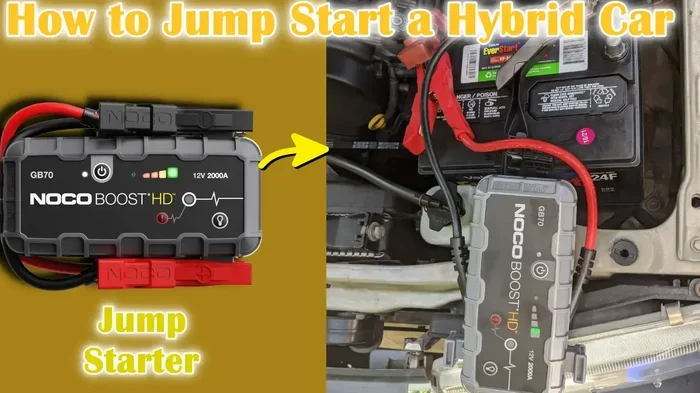
A hybrid jump box is the best tool for the job. It is a small, self-contained battery pack that can boost a 12V hybrid battery without another vehicle. To use it, connect the red clamp to the positive 12V terminal and the black clamp to the grounding bolt. Turn on the jump box, then start the hybrid. Most jump boxes have a built-in flashlight and USB ports, so they double as an emergency power bank. I recommend keeping one in your trunk, especially if you drive a hybrid SUV or sedan that sits idle for long periods.
Preventing a Dead Hybrid Battery
The 12-volt auxiliary battery in a hybrid can die if the car is not driven regularly. The hybrid system draws a small amount of power even when the car is off, to maintain the computer’s memory. Over time, this can drain the 12V battery. To prevent this:
- Drive your hybrid at least once a week for 20 to 30 minutes.
- Use a battery maintainer charger if the car will sit for more than two weeks.
- Check the 12V battery health during regular hybrid maintenance. A mechanic can test the voltage and predict failure.
- Turn off all accessories before shutting down the hybrid. This reduces the load on the 12V battery when the car is off.
Expert Insight: Hybrid battery health depends on both the high-voltage and 12V systems. A weak 12V battery can cause the hybrid to enter a protective mode, limiting power and triggering warning lights. Keeping the 12V battery strong is one of the easiest ways to avoid a trip to the shop.
When to Call a Professional
Signs of a Bigger Problem
Sometimes a dead 12V battery is just a symptom of a deeper issue. If you successfully jump-start the hybrid but it dies again within an hour, the alternator or voltage regulator may be failing. If the hybrid warning lights stay on after starting, the power control unit might have stored a fault code. A professional can read these codes and perform a hybrid battery reset if needed.
Hybrid Battery Health Check
A certified hybrid technician can test both the 12V and high-voltage batteries. They use special diagnostic tools that communicate with the hybrid system. If the high-voltage battery is degraded, it may not hold a charge, and the gasoline engine will run more often to compensate. This reduces fuel efficiency and can cause the car to enter “limp mode.” In such cases, a hybrid battery replacement might be necessary, but only after a thorough diagnosis.
Do not ignore persistent issues. A hybrid system is complex, and improper handling can lead to expensive repairs. If you are unsure about any step, it is always safer to call a roadside assistance service that has experience with hybrid vehicles.
Can You Jump-Start a Hybrid? Yes, you can, and now you know exactly how. The key is to focus on the 12-volt auxiliary battery and never touch the high-voltage system. By following the step-by-step guide, you can safely boost your hybrid car and get back on the road. Remember to keep a hybrid jump box or jumper cables in your emergency kit, and always read your owner’s manual for model-specific instructions. With the right knowledge, a dead hybrid battery is just a minor inconvenience, not a disaster. Take care of your hybrid’s 12V battery, and your hybrid will serve you well for many miles to come.
Frequently Asked Questions
Is it safe to jump-start a hybrid car?
Yes, it is safe as long as you only boost the 12-volt auxiliary battery. Never attempt to jump-start the high-voltage battery directly. Follow the correct cable sequence and wear safety glasses and gloves. If you are unsure, use a hybrid jump box instead of jumper cables.
Where is the 12-volt battery located in a hybrid?
The location varies by model. In many hybrids like the Toyota Prius, the 12V battery is in the trunk behind a trim panel. In others, it is under the hood near the fuse box. Check your owner’s manual to find the exact spot and the designated jump-start terminals.
Can I use a hybrid jump box instead of another car?
Absolutely. A hybrid jump box is a compact, self-contained battery pack that can boost your 12V battery without needing a second vehicle. It is the safest and most convenient option. Simply connect the clamps to the 12V terminals, turn on the box, and start the hybrid.
What happens if I accidentally touch the high-voltage cables?
The high-voltage cables in a hybrid are orange and are designed to be safe when handled correctly. However, touching them directly, especially when the system is active, can cause a severe electric shock. Always avoid the high-voltage components and only work on the 12V battery and its terminals.
Will jump-starting a hybrid damage the hybrid battery?
No, jump-starting the 12V battery will not damage the high-voltage hybrid battery. The two systems are completely isolated. The only risk is if you make a wiring mistake, such as reversing the cables or letting them spark. Following the proper sequence prevents any harm.
How long should I let the hybrid run after a jump-start?
Let the hybrid run for at least 15 minutes after a successful jump-start. This allows the alternator to recharge the 12V battery fully. You can then drive the car normally for 20 minutes to ensure the battery is ready for the next start.