How Do I Know How Much PSI Is in My Tire Without Guessing
Knowing your tire PSI is essential for safety, fuel efficiency, and tire longevity. You can check it with a simple gauge, your car’s TPMS system, or at most gas stations. Proper tire pressure prevents blowouts, saves money on gas, and keeps you driving confidently.
Your tires are the only part of your car that touches the road. That means tire pressure matters more than most people realize. How do I know how much PSI is in my tire? It is a question every driver should know the answer to.
PSI stands for pounds per square inch. It measures the air pressure inside your tire. Too little air, and your tires wear out fast. Too much air, and you risk a blowout. The good news is checking your PSI is easy, free, and takes only a few minutes.
In this guide, we walk you through every method to find your tire pressure. You will learn how to use a tire gauge, understand your car’s warning lights, and know exactly what number to look for. No guessing required.
Key Takeaways
- Check your PSI monthly: Tire pressure changes with temperature and natural air loss.
- Use a tire gauge: A manual or digital gauge gives you the most accurate reading.
- Find your recommended PSI on the driver’s door jamb: This is the factory-recommended number for your specific vehicle.
- Check tires when cold: Driving heats up tires and raises PSI readings, giving false numbers.
- Don’t ignore the TPMS light: It exists for a reason and can save you from dangerous tire failure.
- Proper PSI improves fuel economy: Even a small drop in pressure wastes gas over time.
📑 Table of Contents
- What Is Tire PSI and Why Does It Matter?
- How to Check Your Tire PSI Manually
- Understanding the Tire Pressure Monitoring System (TPMS)
- Where to Find the Recommended PSI for Your Vehicle
- Common Tire PSI Problems and How to Fix Them
- When to Get Professional Help for Tire Pressure
- Quick Tips for Maintaining Proper Tire Pressure
- Final Thoughts
What Is Tire PSI and Why Does It Matter?
PSI measures how much air is packed inside your tire. Every vehicle has a specific PSI number that works best. This number is not random. Engineers calculate it based on your car’s weight, size, and handling needs.
Proper tire pressure affects more than just your ride. It impacts safety, fuel economy, and how long your tires last. Here is why it matters so much:
- Safety: Underinflated tires can overheat and fail at highway speeds. Overinflated tires have less grip on wet roads.
- Fuel Economy: Tires with low rolling resistance from correct pressure use less gas. Even a 5 PSI drop can hurt your mileage.
- Tire Life: Underinflated tires wear out the outer edges of the tread. Overinflated tires wear out the center. Both mean you replace tires sooner.
- Ride Comfort: The right pressure gives you a smooth, quiet ride. Too little air makes your car feel sluggish.
Most passenger cars recommend between 30 and 35 PSI. But your car might be different. Always check your owner’s manual or the door jamb sticker for the exact number.
How to Check Your Tire PSI Manually
The most reliable way to check your tire pressure is with a tire gauge. You do not need to be a mechanic. Anyone can do this at home in under ten minutes.
Step-by-Step Guide to Using a Tire Gauge
- Find your recommended PSI. Look at the sticker on your driver’s door jamb. It lists the pressure for front and rear tires.
- Remove the valve cap. Twist it counterclockwise. Keep it somewhere safe so you do not lose it.
- Press the gauge firmly onto the valve stem. You will hear a brief hiss of air. That is normal.
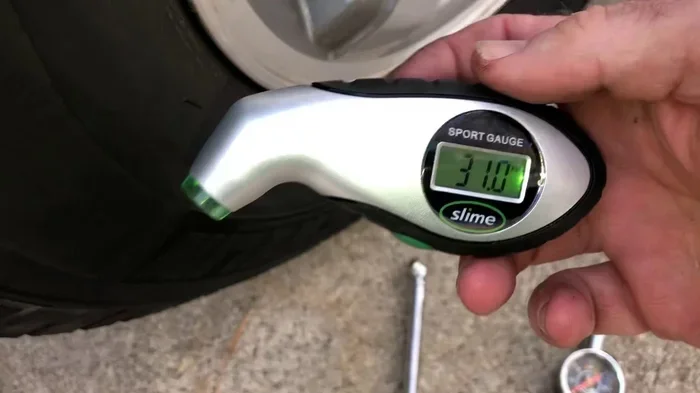
- Read the number on the gauge. A pencil-style gauge shows a sliding mark. A digital gauge displays a clear number on a screen.
- Compare the reading to the recommended PSI. Add air if it is low. Let some out if it is too high.
- Replace the valve cap. This keeps dirt and moisture out of the valve stem.
Types of Tire Gauges
Not all gauges are the same. Here are the most common types you will find:
- Pencil Style Gauge: Inexpensive and compact. It uses a sliding scale to show pressure. These are accurate enough for most drivers.
- Digital Gauge: Easy to read with a backlit display. They often come with a lighted nozzle for nighttime use.
- Dial Gauge: Shows pressure on a round face, similar to a clock. These tend to be very accurate and durable.
You can buy a basic tire gauge for under fifteen dollars at any auto parts store. Keep one in your glove box. You never know when you will need it.
Many drivers also check pressure at gas stations. The air pumps there work fine, but the gauges built into them are often inaccurate. Bring your own gauge for the best results.
Understanding the Tire Pressure Monitoring System (TPMS)
Modern cars come with a tire pressure monitoring system, or TPMS. This is a computer system that watches your tire pressure and alerts you when something is wrong.
What Does the TPMS Light Look Like?
The light looks like a horseshoe shape with an exclamation point in the middle. It usually glows yellow or orange on your dashboard. When you see it, at least one tire is likely below the recommended PSI.
Should You Trust the TPMS Light?
The TPMS light is helpful, but it has limits. It typically only activates when pressure drops 25 percent below the recommended level. That means you could be driving on a dangerously low tire for weeks before the light comes on.
This is why manual checks matter. Do not rely on the TPMS light alone. Use it as a backup, not your primary method.
Also, keep in mind that temperature changes affect your PSI. Cold weather can drop your pressure by 1 PSI for every 10 degrees Fahrenheit. So a light that appears in winter might just mean the air in your tires contracted. Still, always check it when the light comes on.
Where to Find the Recommended PSI for Your Vehicle
Finding the right PSI number is simple. You do not need to guess or call a dealer. The information is right there in your car.
Check the Driver’s Door Jamb
Open your driver’s door and look at the frame or the door itself. There is a sticker or plate bolted there. It lists your vehicle’s recommended tire pressure for both front and rear tires. This is the number you should always follow.
Check the Owner’s Manual
If you cannot find the sticker, your owner’s manual has the same information. Look in the maintenance or specifications section. The manual may also list different PSI numbers for different driving conditions, such as towing or carrying heavy loads.
Check the Tire Information Placard on the Fuel Door
Some vehicles place the tire information sticker on the fuel door or inside the glove box. Check these spots if you have not found it on the door jamb.
Never use the number printed on the tire sidewall. That number is the maximum pressure the tire can handle, not the recommended pressure for your vehicle. Using the maximum number can give you a harsh ride and uneven wear.
Common Tire PSI Problems and How to Fix Them
Even with regular checks, tire pressure problems happen. Here are the most common issues and how to solve them.
Slow Air Leaks
A slow leak is the number one cause of low tire pressure. It can come from a small nail, a worn valve stem, or a poor seal between the tire and rim. If you find yourself adding air every week, get your tires inspected. A mechanic can find and fix most leaks quickly.
Temperature Changes
As seasons change, so does your tire pressure. Winter cold lowers PSI. Summer heat raises it. Check your pressure more often during seasonal transitions. This keeps you from being caught off guard.
TPMS Sensor Battery Failure
TPMS sensors have batteries that eventually die. When a sensor battery fails, the light may stay on even if your tires are fine. A mechanic can replace the sensor and reset the system.
Punctures and Road Hazards
A nail, screw, or piece of glass can puncture your tire. These often cause slow leaks that are hard to notice at first. If your TPMS light comes on after driving over debris, check your pressure right away.
Taking care of tire pressure problems early saves you from bigger headaches. It also keeps you safe on the road. Can I drive my car after it overheats? Tire issues can cause overheating too, so staying on top of pressure helps prevent that kind of cascading problem.
When to Get Professional Help for Tire Pressure
Most tire pressure checks are easy to do yourself. But there are times when you should see a professional.
If you notice your tires losing pressure frequently, a shop can check for leaks using soapy water or electronic leak detectors. They can also inspect your valve stems, rims, and tire condition.
During routine maintenance like an oil change, ask the technician to check your tire pressure. Many shops do this for free. Do mechanics do a lot of math when calculating proper inflation? Yes, they use the vehicle specifications and load calculations to make sure your tires are set up right.
If you are mixing tire types or sizes, the PSI recommendation may change. A tire professional can help you find the right pressure for your setup. This is especially important if you have upgraded your wheels or tires from the factory specs.
Also, if your TPMS light keeps coming back on after you have inflated your tires, the sensor itself may need replacement. A mechanic can diagnose this fast and get you back on the road safely.
Quick Tips for Maintaining Proper Tire Pressure
Here are some simple habits that keep your tires in great shape:
- Check your PSI once a month. Set a reminder on your phone so you do not forget.
- Check before you drive. Tires lose pressure as they sit overnight. Checking in the morning gives the most accurate reading.
- Keep a tire gauge in your car. Do not rely on gas station gauges alone.
- Check your spare tire too. A flat spare tire will not help you when you need it most.
- Do not bleed air from a hot tire. Wait at least three hours after driving for an accurate reading.
- Replace valve stems every few years. Old rubber stems crack and leak air slowly.
These small habits add up to big savings. Properly inflated tires last longer, ride better, and keep you safer. Think of it as one of the easiest ways to take care of your car.
Final Thoughts
How do I know how much PSI is in my tire? Now you know the answer. You can use a simple gauge at home, trust your TPMS light as a warning system, or check at a gas station. The key is to stay consistent and check regularly.
Proper tire pressure is one of the easiest maintenance tasks you can do. It takes just a few minutes and costs almost nothing. Yet it protects your safety, saves money on fuel, and extends the life of your tires. Do not let guessing be part of the process.
Make tire pressure checks part of your routine. Your car, your wallet, and your family will thank you. And remember, if you ever notice something unusual with your tires, do not hesitate to visit a trusted mechanic for help.
Frequently Asked Questions
How often should I check my tire PSI?
Check your tire pressure at least once a month. Temperature changes and natural air loss mean your PSI can drop over time. A quick monthly check keeps you ahead of problems.
Can I use the PSI number printed on my tire sidewall?
No. The number on the sidewall is the maximum pressure the tire can handle. Your vehicle’s recommended PSI is usually lower and listed on the driver’s door jamb sticker.
What should I do if my TPMS light comes on?
Check your tire pressure with a gauge as soon as possible. If the pressure is low, add air to the recommended PSI. If the light stays on after inflating, the TPMS sensor may need attention from a mechanic.
Does cold weather affect tire PSI?
Yes. Cold weather causes the air inside your tires to contract, which lowers PSI. For every 10 degrees Fahrenheit drop in temperature, your pressure can decrease by about 1 PSI.
Is it safe to drive on a tire with low pressure?
It is not safe. Underinflated tires can overheat, reduce handling, and increase the risk of a blowout. If your tire is significantly low, add air before driving or get roadside assistance.
Can I check tire PSI with just my eyes?
No. You cannot accurately judge tire pressure by looking at a tire. A tire can be underinflated by 10 PSI and still look normal. Always use a tire gauge for an accurate reading.
=== CONCLUSION ===
Knowing your tire PSI is one of the simplest yet most important things you can do as a driver. Whether you use a manual gauge, your car’s TPMS system, or a gas station air pump, the goal is the same: keep your tires at the right pressure. Do not guess. Check regularly and stay safe on every drive.